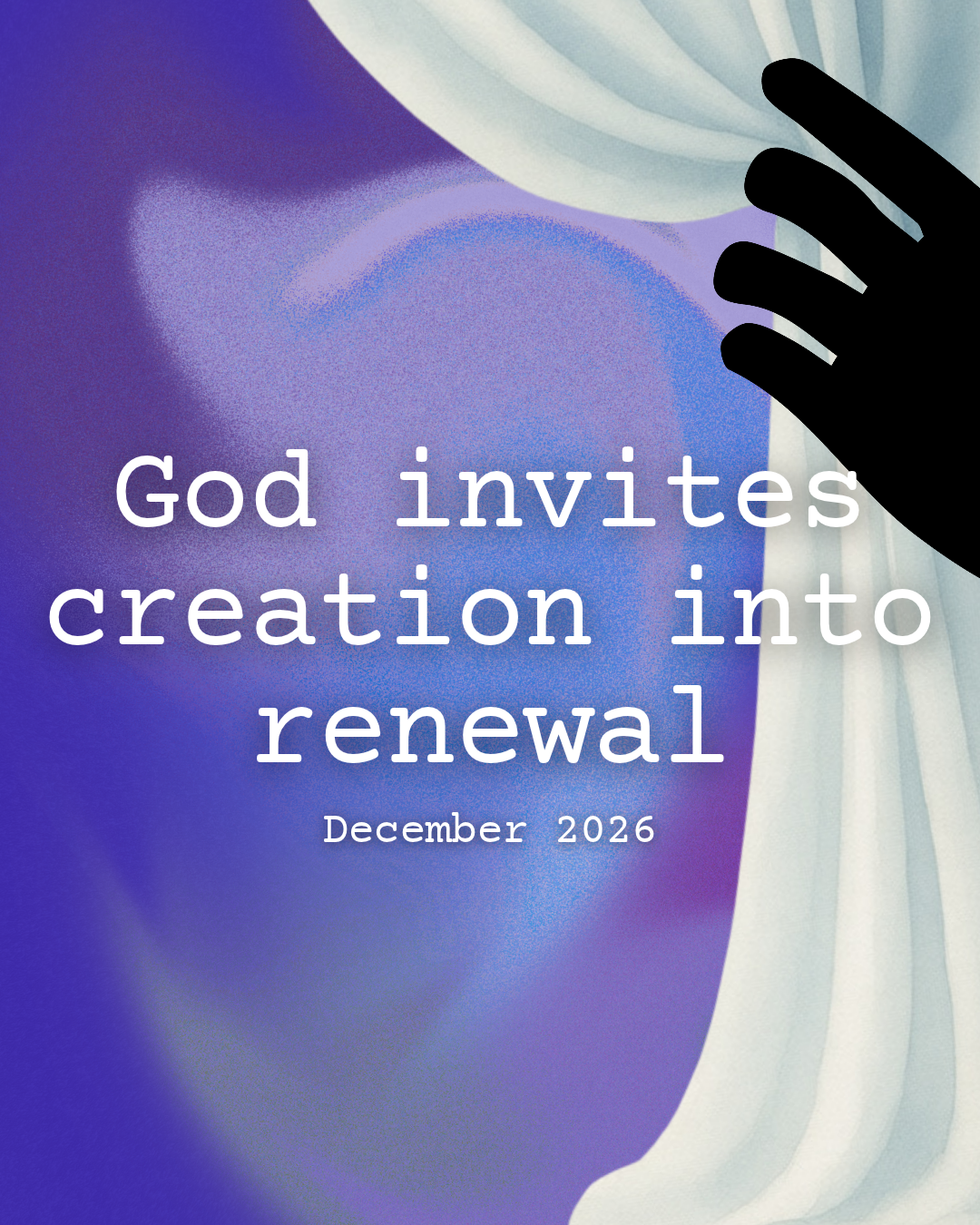
God Invites Creation into Renewal
I just let my clay creation thunk down into the trash can.
I spent a while trying to sculpt a vase with a sort of orchid-shape, having delicate leaves curling up around the outside. It looked pretty at first, but I’m no master-sculptor, and the air-dry clay started to crumble as it dried; soon all the leaves had broken off.
I’m not very sentimental in some ways. Amy is. She gasped in horror as I dropped it into the trash. “What!?” she asked. “You’re throwing it away!? But you made it!”
I shrugged. “It’s broken.”
When a creation is broken, there are only so many options. You can try to repair it, try to accept it in the shape you didn’t intend, try to repurpose it… or discard it. In fact, if you leave this version of it in the trash, you are free to start over, to try again, to make a better second version of your orchid vase (or story, or painting.)
But what God does with His broken creation is very different. His picture of salvation is more interactive than fishing my vase out of the trash. God can make the vase soft again, rework it, and then (this is where the metaphor falls apart) give it little vase hands and guide them to re-sculpt broken clay with Him.
…You get it.
The Biblical story begins with creation, but very quickly, it shows us that the creation is broken. That broken creation is the one we are familiar with. This theological brokenness is hardly something new, but it’s more interesting than we think.
In one of my favorite passages, Romans 8 describes that creation itself is groaning and in pain, using language that is specifically reflecting back to the curse of the broken world. But it isn’t the pain of dying–it’s the pain of new life. Creation is groaning towards something. What is it frustrated and crying out for?
“For the eagerly awaiting creation waits for the revealing of the sons and daughters of God.” (Romans 8:19)
Astonishingly… us.
“And not only that, but also we ourselves, having the first fruits of the Spirit, even we ourselves groan within ourselves, waiting eagerly for our adoption as sons and daughters, the redemption of our body.” (Romans 8:23)
This tells us that our intended role in creation is much more lively than just passive recipients of God’s grace. For some reason, our redemption is tied to the hope of a coming future, not just our present-tense state as saved.
We tend to read these passages about being good for the world and immediately think assignment. What are my tasks? What should I build? What injustice should I repair? What ministry should I perform?
But it is remarkable to see that this language doesn’t emphasize what we’re going to do. It emphasizes “the revealing.” It doesn’t emphasize our actions, but our bodies.
Our role in the renewed creation is as created things of God. Our redeemed embodied existence is somehow part of the good news for the rest of creation. In some way, it’s like the world is clambering for an art opening, featuring God’s renewed creatures. Somehow, what God is making of us will be good news for the rest of creation.
This thought is strengthened by the oft-quoted verse, Ephesians 2:10: “For we are His workmanship, created in Christ Jesus for good works, which God prepared beforehand so that we would walk in them.”
The good works aren’t an afterthought, tacked onto salvation once God has successfully rescued us. We are created in Christ Jesus for them. Which suggests that this process of redemption is still creative: God is making something of us, and what He is making is designed to participate in what He is doing next.
I think Colossians 1 helps make sense of this because it refuses to separate creation and redemption into two different projects. It describes Christ as “the image of the invisible God, the firstborn of all creation,” and then says that “all things have been created through Him and for Him.” This is the same Christ in whom “all things hold together” — and then, only a few sentences later, Paul says that through Christ God is reconciling “all things to Himself.”
That repetition matters. All things were created through Him. All things are held together in Him. All things are being reconciled through Him.
It isn’t as though God made one creation in Genesis, watched it collapse, sighed heavily, and launched a completely unrelated rescue operation called Christianity. Redemption belongs to the same creative purpose from the beginning. Jesus is not God’s Plan B for a failed universe. The One through whom creation came into being is the same One through whom creation is being reconciled.
And the goal of that reconciliation is remarkably broad. Christianity sometimes gets reduced to an intensely private question: Am I saved? Where will I go when I die? And of course our individual reconciliation with God matters enormously. But Colossians does not let the scope of salvation remain that small. God is reconciling all things to Himself, whether things on earth or things in heaven. Romans describes creation itself waiting for freedom. Apparently God’s concern is not merely extracting a handful of souls from a doomed physical world. He remains committed to what He made.
And this is where the vase with little hands returns.
Because God’s renewed creatures are apparently not intended merely to stand around being lovely examples of His workmanship. They are involved in what He is doing; they are living artworks, not dried clay.
2 Corinthians 5 begins with another one of those famously quoted statements: “If anyone is in Christ, this person is a new creation.” But we often stop there, which is unfortunate, because Paul immediately tells us what God does with these newly created people: “God, who reconciled us to Himself through Christ and gave us the ministry of reconciliation.”
He reconciles us. Then He gives us reconciliation to participate in.
And a few verses later Paul makes a claim that is truly bizarre, if you think about it at all: “Therefore, we are ambassadors for Christ, as though God were making an appeal through us.”
This is one of those statements that I think we can hear so often that we miss the peculiarity. God is God. He does not require an ambassador because He lacks access to the country. He does not need us because His own communication skills are insufficient. If God wanted reconciliation to be something He accomplished entirely without creaturely involvement, surely He could do that.
Instead, He reconciles creatures and then makes those creatures participants in reconciliation.
This pattern has shown up again and again throughout this study. God creates a world full of interdependence, where created things nourish and sustain one another. He fills His creatures and allows them to become bearers of His presence. He allows what He has made to affect Him. He sustains creation continually, while simultaneously designing creatures capable of participating in the sustaining of one another. Over and over, God’s creativity is not threatened by creaturely agency. Somehow, His sovereignty is expansive enough to make room for it.
And here, at the end of the story, He does it again.
God’s creativity is so generative that He creates creatures capable of participating in creation’s renewal.
That does not mean we cause the new creation. There is a theological nightmare available to us here if we start imagining that, provided Christians work hard enough at justice and art and recycling and community organizing, we will eventually finish building the Kingdom of God and hand Jesus the keys. Scripture simply does not present the renewed creation as a human accomplishment.
Revelation 21 begins, “Then I saw a new heaven and a new earth.” The holy city comes down from heaven from God. And the One seated on the throne says, “Behold, I am making all things new.”
Not tossing the ruined stuff and making “all new things!” But all things new.
Revelation gives us images of healing, restored relationship, God dwelling with humanity, tears wiped away, death gone. The end toward which God is moving creation is not simply replacement. It is renewal.
Which means that when we participate in reconciliation, restoration, healing, cultivation, peacemaking, truth-telling, beauty, care — when we push against the forces that deform creation — our work can genuinely correspond to the future God has promised.
Not cause it. Not complete it. Not force God’s hand. But correspond to it.
I think artists have a particularly natural way of understanding this because so much of making begins with seeing what is not there yet. You look at a blank page and imagine a story. You look at an empty stage and imagine people inhabiting it. You hear music that does not yet exist. You look at a lump of clay and, if you are perhaps more competent than I am, see an orchid vase.
Artists practice hope constantly. We look at what is in front of us and imagine that it might become something else.
Christian creativity can do something similar with the world itself.
What broken thing can I help mend? What beauty can I cultivate instead of merely describing? What possibility can I help someone imagine? What story might reconcile someone to their own humanity, or help them see their neighbor differently? What deserves restoration rather than disposal? What has been ignored that I can notice, forgotten that I can preserve, distorted that I can tell truthfully?
Christian creativity does not have to merely describe the world as it is. It can participate, however partially, in loving the world toward what God has promised it will become.
And I want to immediately make that idea less grandiose, because I know how artists work. We are quite capable of turning “participating in the renewal of creation” into a crushing expectation that every watercolor needs to dismantle a systemic injustice before lunch.
Not every work needs to “change the world” in some enormous, measurable way. Sometimes renewal looks like practicing and failing. Sometimes it looks like teaching a kid. Sometimes an ugly room needs something beautiful hung on the wall. Sometimes someone just needs to laugh.
Scale and faithfulness are two different things entirely.
And, frustratingly for those of us who like evidence that our lives are useful, we may never know exactly what our work did. We may make something that matters tremendously to three people and barely registers anywhere else. Something we think is important may disappear almost immediately; something tossed off casually may remain with somebody for decades. We cannot control every consequence of what we create any more than we can control every consequence of anything else we do.
Our job is not to prove that our work transformed creation. Our job is to be faithful participants in the direction God is already taking it.
That is where I think this entire study has led me.
The God of Scripture has never seemed especially interested in making a creation that merely sits still and admires Him. He makes seeds that become trees that make more seeds. He makes human beings who make music and children and cities and bread and bad clay vases. He creates creatures capable of loving one another, sustaining one another, affecting one another, hurting one another, repairing what has been hurt.
He makes things that can make things. He gives life that can give life.
The image of my little vase with hands is ridiculous, obviously. But I think that is part of why I like it. What God does is ridiculous in exactly that way. The broken creation is not merely repaired by a distant Maker. It is softened, remade, filled with His Spirit, and invited to participate in the remaking.
We new creations also form God’s new creation. Could you hope for anything so wonderful and strange?