God Sustains His Creation
“Peek-a…” An adult covers their face with their hands. A baby stares at the place where their favorite person has apparently just vanished from reality. “BOO!” The hands drop and—astonishingly!—the person exists again! Delight. Shock. Hysterical laughter. (Repeat approximately four hundred times.)
Eventually, of course, we develop what psychologists call “object permanence,” the understanding that something continues to exist even when we cannot see it. As adults, this feels so obvious that we hardly recognize it as a belief at all. We don’t need to see all of our things all the time; in fact, a tidy home with everything out of sight might be considered the ultimate act of faith for our infant selves.
But we know: Things exist, and then they keep existing. Obviously.
Except… why?
Earlier this year, we began this study with the Christian doctrine of creatio ex nihilo: God creates from nothing. There was no preexisting cosmic clay for God to shape into galaxies and giraffes and people. Everything that is not God ultimately owes its existence to God.
But there is another implication of that doctrine that I think is much harder to wrap our minds around: If creation has no source of existence apart from God… that remains true throughout its existence.
We tend to picture creation a little like our own creative work. I can make a ceramic bowl and leave the room, and the bowl does not need me anymore. I can write a book and die, and the book may continue to exist for hundreds of years without its author. Human makers bring things into forms, but then they exist independently of us.
But according to Christian theology, that is not quite what God does.
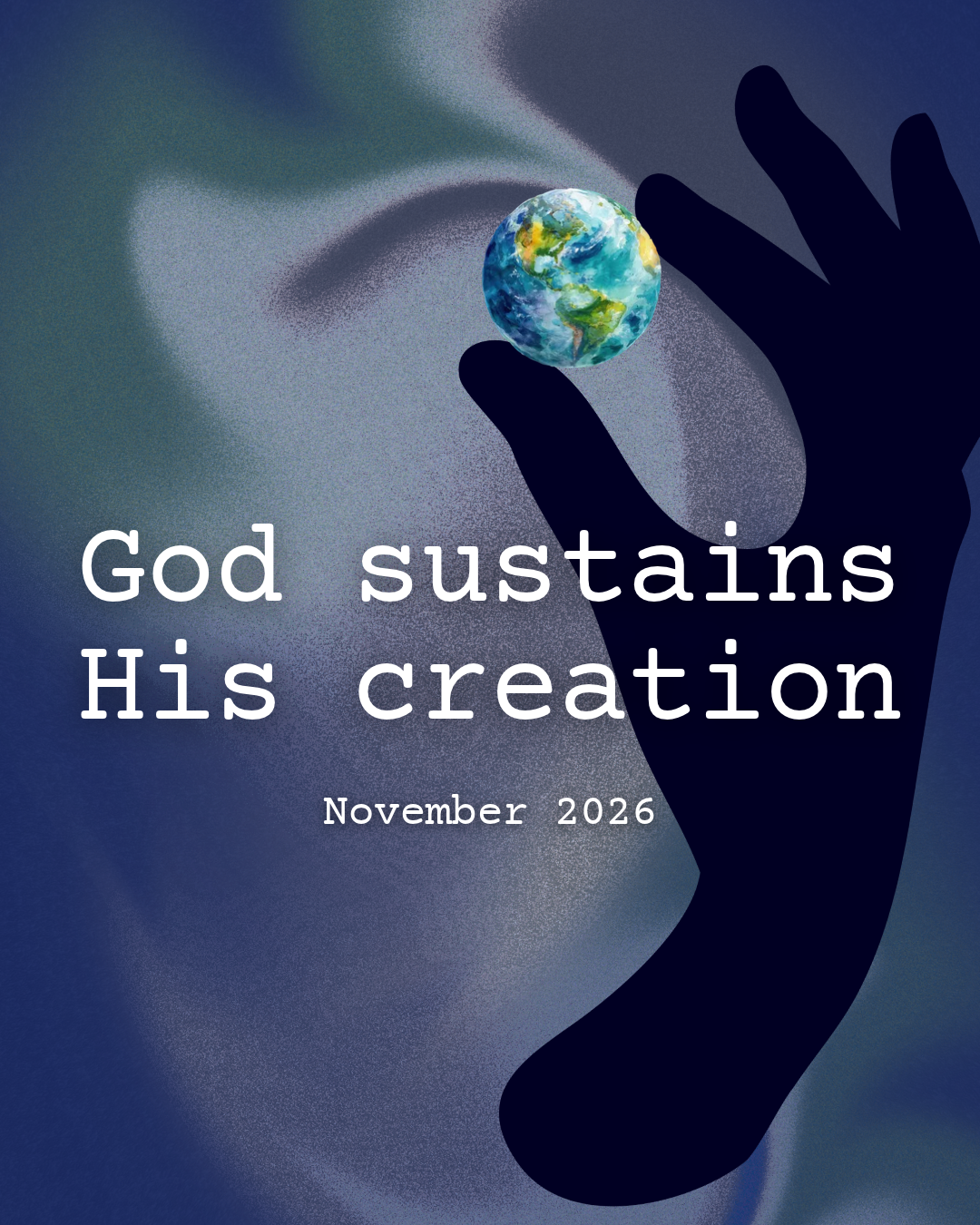
There is a theological term for this: Divine conservation. This is the idea that creation is continually dependent upon God. In a chapter on creation and providence, theologian Simon Oliver describes God as holding His creation in His hand over an incomprehensible chasm of nothingness. If He withdraws His hand, we plunge back into that chasm.
Not because “nothingness” is some dark force waiting below us to gobble up the universe if God slips. Nothingness is not a thing. It has no power. That is precisely what makes the image so strange; nothingness does not need an active power. It is the default state of anything and anyone except for God, who is alone self-existent.
And yet here we are, existing. Not nothing.
It turns out, object permanence is something we can take for granted because of the steadfast nature of God. Object permanence is really a byproduct of relational faithfulness.
This is not just a philosophical imagining. Scripture describes God’s relationship with creation in surprisingly active, present-tense language. Hebrews 1:3 says that Jesus is “sustaining all things by his powerful word.” Colossians 1:17 says, “He is before all things, and in him all things hold together.” Paul tells the Athenians in Acts 17 that God “gives everyone life and breath and everything else,” and then quotes the startling statement, “For in him we live and move and have our being.”
Live. Move. Be. Apparently even the fact that I am currently sitting here existing is dependent.
I think we imagine existence almost like a switch that God flipped on at the beginning: once the universe was “on,” it stayed on until something or Someone comes to switch it off again. The popular idea of Deism is similar; God made something to run perfectly smoothly on its own, and He needn’t be involved because He needn’t continue to fiddle with it.
But Scripture gives us something more intimate than that. Christ is sustaining all things. In Him all things hold together. Job 34 imagines that if God were to withdraw His Spirit and breath, all living things would perish together and humanity would return to dust. Nehemiah 9 puts creation and preservation side by side: God made the heavens, earth, seas, and everything in them, and He continues to give life to them.
Creation never graduates from needing its Creator.
And I think this expands what we mean when we talk about God providing.
Provision is one of those Christian words that can easily become associated with interrupting moments. We pray because rent is due, and surprise! Freelance work appears for us! Or we have no energy to cook, and ta-da, someone brings over dinner!
And of course, I believe God provides in those moments, but we risk missing SO much of God’s provision because it is so ordinary. We take for granted God’s sustaining grace. We take for granted that He, in every way, keeps us going.
That’s why we are called to pray for daily bread. Nowadays, when many are fortunate not to worry about their next meal, I watch pastors turn this simple sentiment into something more abstract; into having patience for their kids day by day, or having enough energy and time to meet a deadline. But I think the prayer is actually really straightforward. We aren’t meant to take existence for granted, even at very basic levels. Day by day, He provides.
Creation is sustained within itself as we take in bread (and water, and air)–like we talked about previously, there is a web within creation of interdependence, and that is undoubtedly a facet of God’s provision. But I think God’s provision goes even further, from within creation to outside of it; all of it ceases to exist without God.
Something as simple as daily praying for God’s provision is an important reminder that dependence is an intentional part of creaturehood, even beyond what we know we need.
And I think this ongoing dependence tells us something fascinating about the creativity of God.
We really like beginnings. The new idea. The exciting conversation where everyone says, "We should make this!" A blank canvas. Opening night. The first completed draft. We think of creation and beginning as synonymous — we marvel at the shift from nothing to something, and we want to put everything that comes after in montage. Maintenance is tedium. Chores, fixing broken things, loading and unloading the dishwasher, finding another typo in your sixteenth revision. Nowadays we're happy to just glance at a clean before and after.
But if sustaining creation is part of the creative activity of God, maybe we have drawn the boundaries around creativity too narrowly.
God does not become bored with creation once the exciting part of inventing galaxies is over. He tends what He has made. He feeds. He preserves. He continues. Faithfully, He continues to uphold each of us, and that tree we're fond of, and the ocean we half-fear, and the black holes we can perceive but still have no real understanding of.
I think about this a lot when it comes to ReNew York. The events that feel most alive — the ones where something real seems to happen in the room — are usually preceded by weeks of emails we didn't want to write, logistics we had to redo three times, and that special joy that comes from unfolding and refolding heavy tables that fill our itty bitty New York square feet. None of that is the creative vision. All of it is what makes the creative vision possible. And honestly, some of the most meaningful work we've done for our artists has been in the returning — this community is still here, and so are you.
I've discovered that there is genuine creativity in tending. Not every act of sustaining is glamorous or even noticeable. But have you ever visited a museum whose paintings are still vivid, a cathedral whose stonework is still intact, a garden that blooms each spring because someone has cared for it beyond the initial planting? We receive beauty that has survived because someone chose continuation over novelty. That is its own form of making.
Even in our own crafts this is unmistakable. A dancer can perform because the body has been trained and fed and rested — the art lives in the ongoing sustaining of the instrument. A song survives because someone teaches it to another person. A theatre company has to pay its bills and sweep its floors and keep its doors open for any theatre to happen there at all. The work of continuing is still work, and it belongs inside our understanding of creativity, not outside it.
Now — a necessary caveat, because I can already hear the anxious among us: this does not mean everything we begin must be sustained forever. God is the Sustainer of creation; we are not. Some projects are supposed to end. Some organizations should close. Some drafts should be abandoned with prejudice and never spoken of again. Rest is not a failure of maintenance — there are seasons where sustaining our own bodies actually requires putting things down. I am not suggesting that the half-finished novel you haven't touched in four years is a spiritual obligation.
But I wonder whether some of us have mistaken the loss of novelty for the loss of creativity. And I wonder whether some of the most Godlike work we do is not making another new thing, but lovingly seeing what is already entrusted to us and quietly working toward its flourishing.
And here is the other side of this, which matters just as much, particularly if you are someone who carries a lot:
You are not only a sustainer. You are sustained.
The same theology that dignifies the quiet work of continuing also releases us from the terrifying idea that things keep existing because we are holding them together. I am not holding existence at all. You are not keeping atoms organized. Whatever work has been entrusted to you, whatever people you love, whatever fragile creative thing you are trying to keep alive — all of it exists inside a creation that was being upheld by God long before you arrived in it. His hand was already under it. It is still there.
This does not make our participation meaningless. We participate in sustaining things because we are ourselves being sustained. We give daily bread because we receive it.
Our lives are carried through thousands of processes we neither initiate nor understand, and behind all of it, sustaining all of it, is the God who has never once decided that what He made was no longer worth holding.
This month, before you sit down to do work–new and exciting or tedious and sustaining–try to remember what a miracle it is that God is actively, in that moment, sustaining the world. That you are here. That your lungs and heart and immune system work without you needing to ask.
And consider that the God who is sustaining your very life might also be interested in sustaining your work.
Creation is not merely evidence that God once had a spark–of love, of caring, of creativity.
Its continued existence tells us that He has not stopped.