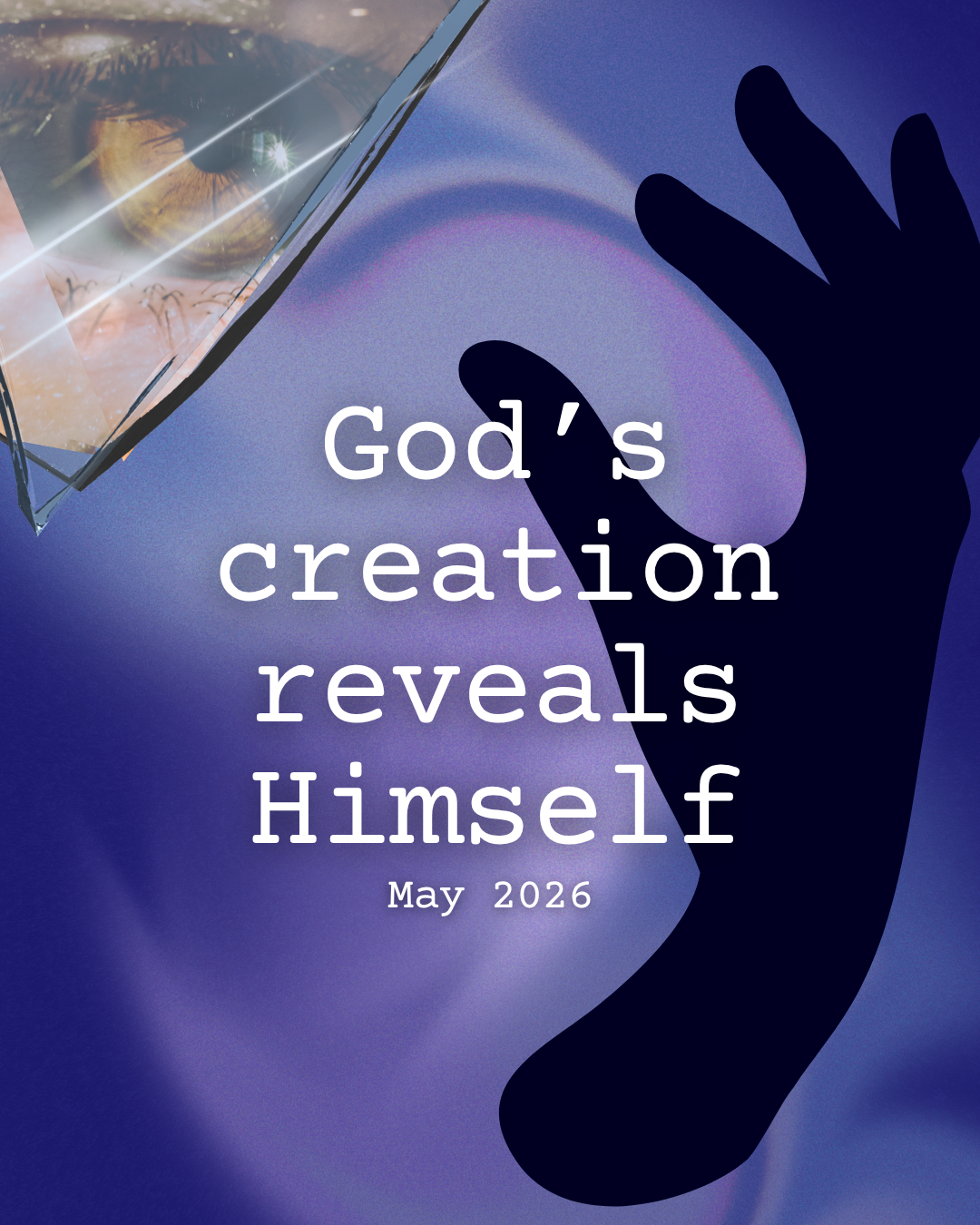
God's Creation Reveals Himself
It’s hard to miss the cultural moment we’re in. Astrology is everywhere again—birth charts, rising signs, Mercury in retrograde. Language that not long ago felt niche now shows up in casual conversation, and people who would never describe themselves as “religious” are still perfectly comfortable saying the cosmos has something to do with their personality or their timing.
But this is not a new trend; it’s an ancient impulse. It’s interesting that with all our advancements, we still look at the natural world and expect it to mean something. We still look at the sky and wonder if it knows something we don’t.
In other words, we still believe—almost instinctively—that creation reveals something.
The question is what? And to what end?
Modern Western thought has trained most of us to think of knowledge as cold fact: data to extract, tactics to apply, something you can leverage if you’re smart enough. If creation were just a hidden dataset to decode, then it would basically function like a lifehack. You could use it to predict outcomes, game systems, or—if we’re being honest about where this tends to land for a lot of us—optimize your art for attention. “Consult the stars so your post performs better” is not that far off from how we already think.
But Scripture speaks about truth differently. In the Hebrew imagination, truth isn’t just correctness; it’s relational. It shares its roots with faithfulness. Which means there’s a real difference between knowing facts and knowing a person. You can memorize information about someone and still not know them at all (which, if you’ve ever gone on a truly terrible first date, you already know.)
So which kind of knowledge does creation offer? Are the stars a locked filing cabinet of useful information, or are they more like a voice making an introduction?
Scripture is surprisingly direct about this. “The heavens declare the glory of God,” Psalm 19 says. Paul writes that God’s invisible attributes can be perceived in what has been made (Romans 1:20), and in Acts 17 we’re told that God ordered the world so that people would seek Him and perhaps reach out and find Him. Creation is not silent or neutral. It is doing something. It declares, it pours forth, it points us toward a Person.
Once you start looking at the world that way, it feels less like a puzzle to solve and more like a conversation you’ve been dropped into mid-sentence. You see things differently: the immune system, with its incredibly specific and occasionally overzealous ability to distinguish between what belongs and what doesn't; kangaroos, which feel like a slightly unserious design choice until you think about what a pouch implies about provision and dependence; cherry blossoms that stubbornly refuse to flourish without human tending, insisting on relationship. These aren’t just interesting facts you store away for trivia night. They start to feel like glimpses—little lines in a much larger story that hint at order, care, limitation, and interdependence.
But it’s entirely possible to notice all of that and still keep God at a distance. To infer, but not encounter. To treat creation like a set of clues without ever actually following them anywhere.
Scripture doesn’t leave us there. God has designed us to know him, not just know about Him–and the Bible tells us mankind was made in the image of God. So God steps into mankind, and “The Word became flesh” (John 1:14).
You see, the God of Christianity wanted to be personally known within His creation so badly, that at the climax of our faith, He entered His creation. If that choice doesn’t prove God’s intention for the world He made, I don’t know what does!
And then, lest we believe that getting to know God in creation is purely a matter of external observation, the Spirit is given—not just alongside us, but within us (John 14:16–17; Romans 8). Suddenly, God’s not just knowable through creation, not just entered into creation, but He’s personally filling His creation through diverse expressions of image-bearers!
Creation points us toward a Person, Christ reveals that Person fully, and the Spirit makes Him present and knowable in and through us.
So for those of us who are makers, the process of creation carries an entirely different significance.
I think most Christian artists have some belief that their art is meant to reflect God in some way. Yet as Francis Schaeffer, author of Art and Faith, deftly remarked: “I am afraid that as evangelicals, we think that a work of art only has value if we reduce it to a tract.” We miss the participatory, relational revelation God intended all along.
If art is, in some sense, autobiographical, then truthfulness about ourselves actually matters. And when we tell the truth in our work—even when it isn’t overtly labeled as “Christian”—the Spirit can use that honesty. Not just to express something about us, but to reveal Christ through us in ways we couldn’t engineer if we tried.
That’s a little uncomfortable. It is much safer to create strategically than honestly. It is much easier to perform than to be known. But art reveals anyway.
We talk about this constantly in culture: whether you can separate the art from the artist. Yet the moment you learn about the person behind a piece of work, the work itself starts to shift. Choices that felt random start to look intentional. Details that seemed incidental suddenly feel like they’re pointing somewhere.
I run into this a lot when I’m helping people edit. A friend once wrote a semi-autobiographical musical and kept insisting that a certain character was the main character’s “best friend.” The only problem was that this “best friend” did not appear until the final scene. The entire show was actually about the main character being quietly cared for by other friends while he kept trying to reach this one person and getting voicemail. I had to gently point out that what he believed about friendship and what he was experiencing in reality might not be lining up. He did not love that note, but it was right there in the story. He hadn’t set out to confess anything, but the work told the truth anyway.
Our art does this to us. It surfaces what we’re holding onto, what we value, and sometimes where something is a little bit broken underneath the surface.
All of this comes back to how we understand truth in the first place. If truth is impersonal—something to extract and use—then of course our relationship to it will be transactional. Knowledge becomes currency, art becomes strategy, and creativity becomes a means of control. But if truth is personal—if truth is Someone—then seeking it starts to look less like analysis and more like relationship.
As we bring the personal back into the truth, as we understand Truth as Him rather than it, suddenly there’s tremendous value to openness and even our fragility. Because what lies within our jars of clay? God Himself.
Schaeffer says that whatever we make as Christ-bearers will reveal Christ. So he says, not just of what we make, but of us made-ones: “We must not only be True. We must be beautiful.” Because that is how God chooses to reveal Himself now–through us!
That’s why our retreat every year begins with talking about how God made us, why our second event this month is led by a make-up artist who empowers survivors to see themselves differently; sound theology demands we see ourselves as more than ourselves. Because if the Spirit really does dwell in us, then we’re not approaching truth from a distance. We’re made in Him and making with Him.
So… what would it look like to make something that is honest instead of optimized? Not just to impress, but to invite?
The heavens are declaring. The skies are proclaiming. Day after day, night after night, creation is pouring forth speech.
What are you saying?