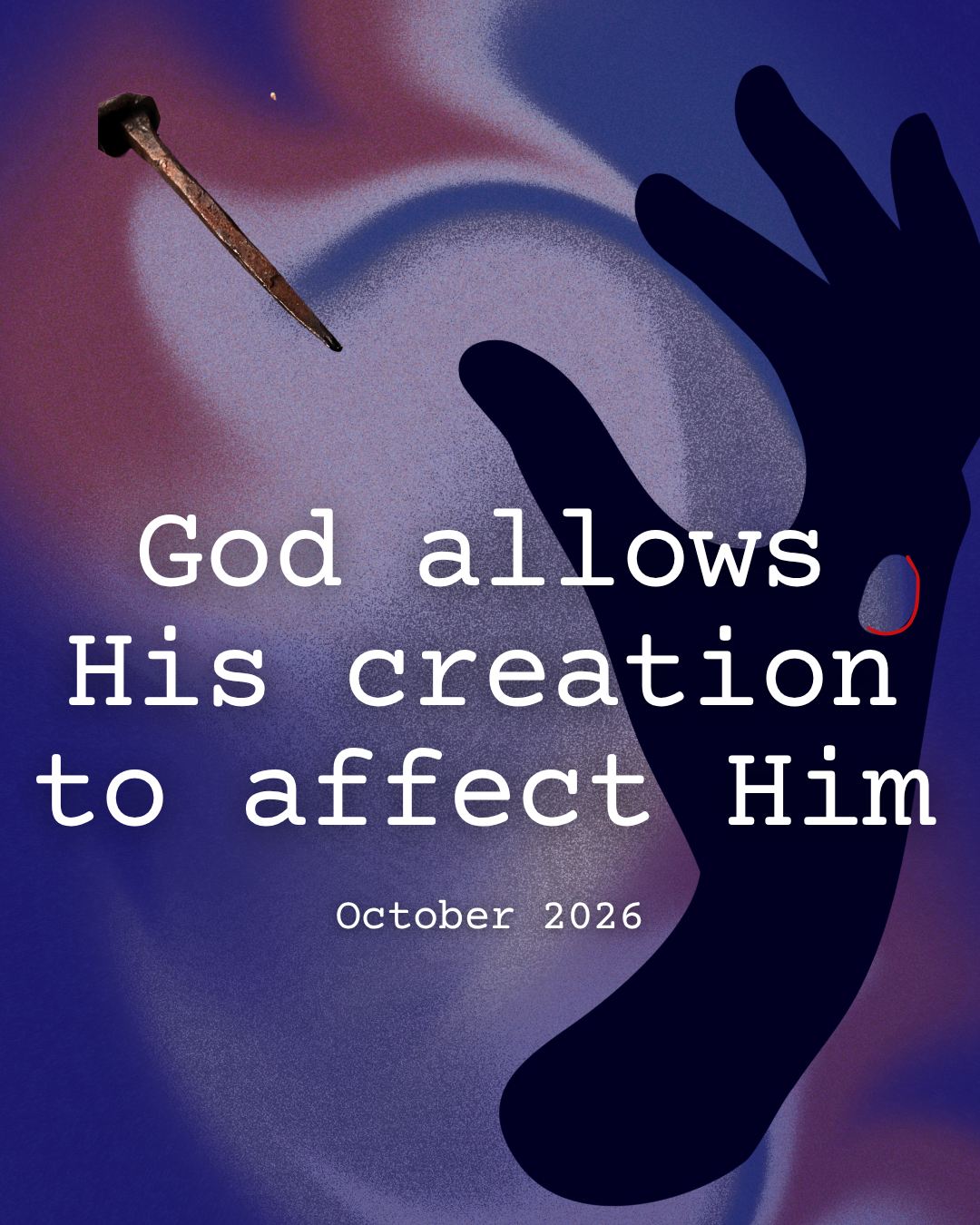
God Allows His Creation to Affect Him
When the risen Jesus, victorious, is reunited with rejoicing disciples on Resurrection Sunday, He does something super weird: He shows the disciples the holes in his hands and his side.
Resurrection has come. Death has been defeated. And yet the wounds are still there. The risen Jesus still bears the marks of the crucifixion.
And it doesn’t seem to be merely a temporary feature of His resurrected body, either: when John sees Christ in heavenly glory in Revelation 5:6, he sees “the lamb standing, as if slaughtered.” These are moments specifically celebrating that death has been defeated. So… Why are Jesus’ wounds still there?
I think this is actually a pattern in the unique theology of God’s creativity throughout Scripture. For whatever reason, God has chosen to let His creation affect Himself.
We’ve already talked about a lot of the ways that God has shaped and marked His creation, and of course, that makes sense to us! It makes sense that His creation bears His image, that it reflects His love, that it is designed to remind us of our dependence upon Him. Likewise, I think we are very mindful of how we form the things we make. Makers usually mark materials—but when we think a little deeper, we realize materials can mark makers, too.
Guitar strings make calluses; clay dries and roughens hands; dye stains our skin; dancers’ bodies are shaped by years of movement. And sometimes the marks go deeper than skin; actors have spoken about how characters have “taught them” things or stayed with them after inhabiting a role, and writers have found that their stories sometimes have a mind of their own and found their worldview altered by writing.
But all of these sorts of changes feel decidedly linked to our humanness, our soft flesh, our changeability, our propensity to grow and learn… It is perhaps something we don’t think about very often, but it’s not a great shock to realize that the things we make might have an effect on us back. It is something entirely different to read the Bible and realize that the eternal God, in His perfect sovereignty, has allowed His mortal creation to affect Him.
And the wounds of Christ are not the first time Scripture suggests this. Long before God enters creation in a body that can be wounded, the Bible describes a Creator who has already made Himself startlingly responsive to what His creatures do.
This starts at the very beginning, in Genesis 6, when it says humans multiply and wickedness and violence grow with them. As God perceives the brokenness, verse 6 says: “So the Lord was sorry that He had made mankind on the earth, and He was grieved in His heart.” This is a strange thing to think about; God made all of creation, including humankind, and declared it was “Good.” He’s also perfect, incapable of making mistakes, so the notion of Him being “sorry” is already uncomfortable and unclear.
But I think this passage hints at an explanation which doesn’t mean God is emotionally unstable, indecisive, or even fallible; the verse tells us “He was grieved in His heart.” God allows Himself to feel grief for His creation because He loves His creation. Such a response then is consistent with God’s loving, steadfast personality, rather than a volatile surprise.
We allow the things we love to affect us, too. We often protect ourselves from distant suffering, scrolling past a news article or avoiding hard realities because our emotional capacity is limited; when suffering belongs to someone we love, that distance becomes much harder. But God who does not have emotional limits enters fully into the love He feels for each of us; He needn’t protect Himself through indifference. Instead, God’s love is shown to us through His responsiveness.
It is clear that God does not consider invulnerability a prerequisite for sovereignty. In fact, I’m reminded of Tozer’s quote in The Knowledge of the Holy: “A God less than sovereign could not bestow moral freedom upon His creatures. He would be afraid to do so.” If I could extend the thought into my own paraphrase, I believe a God who was less than perfect would not allow His creatures to affect His heart. He would be afraid to do so. Instead, the God who created humans and gifted them with free will also loves them with such intimacy that evil becomes more than a rule violation; it has relational consequences.
We see this repeatedly in Jesus as well, who allows Himself to be moved to grief. Of course, we have the famous “Jesus wept” in John 11 as He grieves the death of his friend Lazarus… even though Jesus knows that Lazarus will rise. This shows that God’s good plan does not negate his loving ability to grieve. But there's also this brief vignette in Luke 7:12-15 where Jesus sees at a distance a widow who has lost her only son. It says “When the Lord saw her, his heart went out to her,” and then he raised her son to return him to her. God’s creation might affect not only what He feels, but what He does.
Exodus 32 is one of the strangest and most debated passages in Scripture for this very reason. It shows God angry that the people He is leading out of slavery have made a golden calf for idol worship. He explicitly tells Moses in verse 10, “Now leave me alone so that my anger may burn against them and that I may destroy them. Then I will make you into a great nation.” Then Moses prays for God to spare His people, and verse 14 states: “The Lord relented and did not bring disaster upon His people.”
Again, it is easy to wonder whether this passage undermines the sovereignty of God. But if we remember that God is Moses’ Creator in this moment, I think the image of sovereignty actually becomes richer: this is a sovereignty spacious enough to include meaningful relationship with what God has made, rather than mere puppetry. It forces the question: how is His power great enough to allow for genuinely consequential prayer, like we see here? And the stunning answer: Prayer matters because God has chosen for it to matter. He has built it into what he has made. He has made a world capable of relating to Him and avails Himself continuously to His own world.
And then, astonishingly, God does not remain safely on one side of that responsive relationship. He enters creation Himself. Christianity makes this theology physical.
In Jesus, the Creator enters creation in a body that can actually be affected by it. He gets hungry and tired. People touch Him and feed Him and interrupt Him. His friends comfort Him, disappoint Him, abandon Him. He can be embraced, jostled by crowds, anointed with perfume, struck in the face. Eventually, human beings take created materials — wood, iron, rope — and use them to wound the One who created all of it. The relationship between Creator and creation becomes so intimate that creation can leave marks on God’s own body.
Not because creation could overpower its Creator, but because the Creator’s love drew Him that close.
When the risen Jesus appears to His disciples, resurrection has defeated death — but it has not erased the evidence that He was loved, betrayed, wounded, and killed in relationship with the world He made. And Revelation still shows us the victorious Christ as the Lamb who was slain. The scars are not evidence that resurrection was incomplete; they are evidence that God so loved the world.
The holes in Jesus’ resurrection body make the heart of the Creator something we can touch. His sovereignty transforms what would be destructive about granting creation impact… into something still generative. In fact, in this passage, He breathes on the disciples, mirroring our initial creation in Genesis with re-creation. His role as Creator is decidedly still active.
So what does it mean for us as artists that God allows His creation to affect Him?
I think one implication is that we should expect the things we make to change us.
I think this is particularly important for Christian artists because we can be tempted to approach art with the answer already firmly in hand. We know the message. We know the point. We know what the audience is supposed to learn, and every character or image or story becomes evidence arranged toward a conclusion; we flatten the beautiful, messy world and people we are designing into mere props.
But making something seriously requires attention, and attention has consequences. Spend long enough trying to understand a character unlike you, researching a place you thought you understood, studying a face closely enough to paint it, or listening to another person's story closely enough to represent it honestly, and you may discover things you did not intend to find. That does not mean the artwork somehow possesses greater wisdom than its maker. It means that the act of making has brought you into closer contact with something real.
This does not mean surrendering every conviction to every reaction, or treating change itself as a virtue. God is responsive without being unstable. But if I refuse to let the work change me, I may not really be in relationship with it.
Which brings me to the how. How do we keep from focusing on proving a point? How do we let our work affect us, in imitation of God’s creativity?
I think practically, we have to grow our love.
Because love is what makes responsiveness possible without making it arbitrary. God is not grieved by humanity because He happened to be in a bad mood that day; He grieves because He loves. Our task is not merely to manufacture self-transformation while we’re making, but like Christ, to tangibly choose to draw near. To choose compassion for our characters. To choose to grieve our conflict. To choose to hear what people say in response to us.
Finally, there is another side to this facet of God’s creativity, too: If creation can genuinely affect its Creator, then we have reason to believe that what we make can genuinely matter.
Art can alter how another person sees the world, give language to grief, preserve memory, stir compassion, provoke repentance, become praise, prayer, lament, or testimony. I don’t mean that art gives us some mystical power to manipulate God or control unseen realities, but Scripture gives us a world in which human prayer matters, worship matters, love matters, and what we offer to God is received by Him. Our making belongs inside that same relational world.
A song offered as prayer is still prayer. A painting made in grief can still be lament. A story can shape the imagination through which someone understands God, themselves, or their neighbor. If God has chosen to make His creation consequential, then our creative acts are not spiritually weightless.
We are allowed, then, to make with both humility and expectation: humility because we cannot control what our work will do, and expectation because we live in a world where relationship really does have consequences. What we make may change us. It may change someone else. It may become an offering to God. Most likely, we will never know all of the marks it leaves.
God has made it so what we do and say and make leaves a mark. He bears the marks of His own creation.
Our Creator does not love His creation from a safe distance. Maybe neither should we.