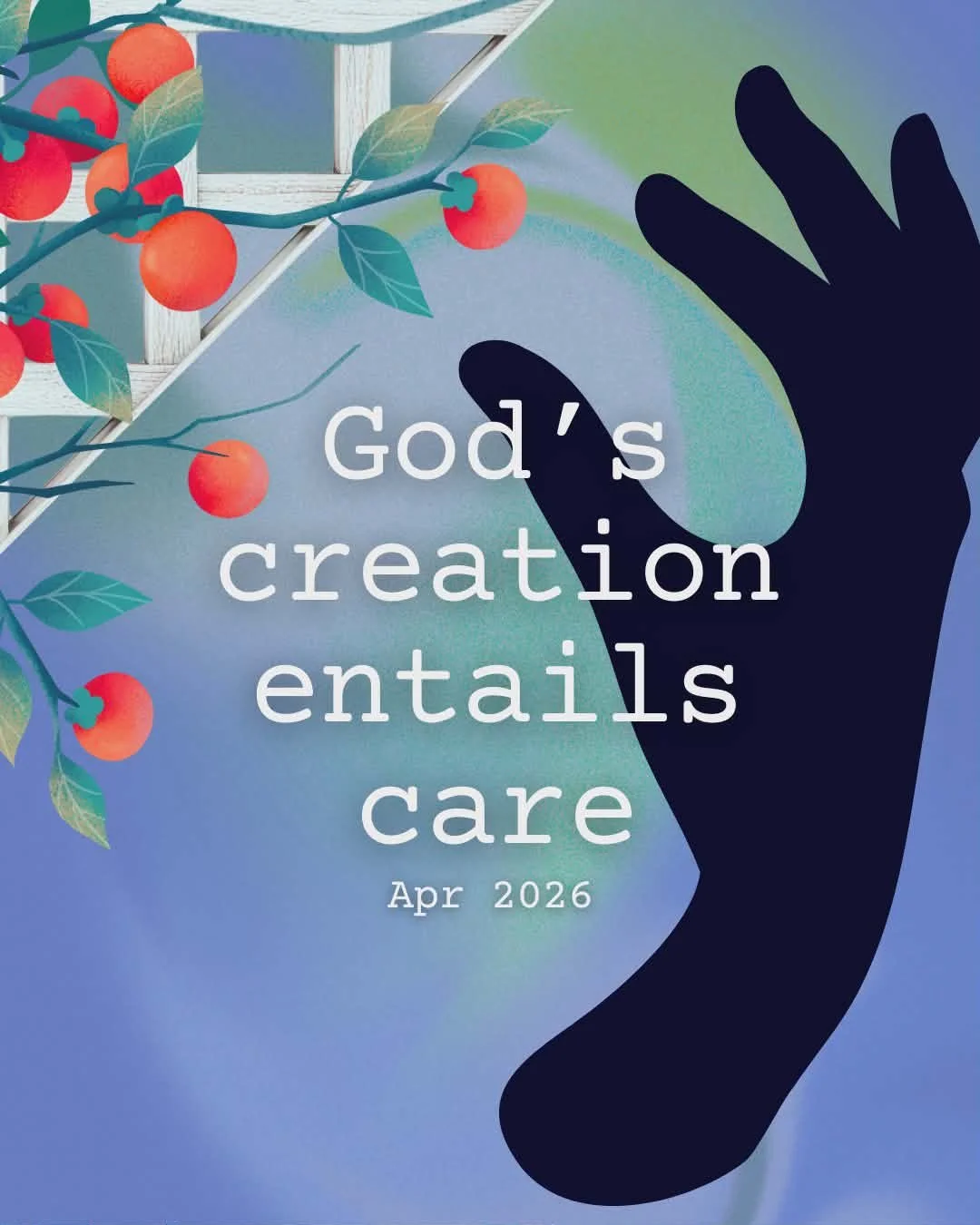
God's Creation Entails Care
I have a confession to make: I’m not a very good recycler.
To be honest, it has always felt to me like the burden of sustainability should fall more on massive corporations and countries than on us as individuals. And even thinking about all the things that have gone wrong in our world—and comparing it to the small changes I kind of know that I should make—can leave me feeling instantly disheartened and overwhelmed.
So this realization, that God’s creation entails care, is a particular challenge for me.
But more than that, it’s actually a very nuanced point.
We live in a culture where caring for the earth is treated as just another in a long list of “shoulds.” And even at best, I usually hear that we were given stewardship of the earth in the same kind of way—like we’ve been handed a job, an extrinsic responsibility placed onto us after the fact.
But in studying the creativity of God, I realized: We’ve been reading that all wrong.
God doesn’t just task us with caring for creation; His creation entails care. That means responsibility isn’t coming from somewhere outside of us—it is intrinsic to the way we were created as part of a bigger, interdependent system.
We fundamentally misunderstand our own creation.
Most of us imagine the creation story like this sort of dollhouse being built, and then we come in to live there. We imagine humans arriving at the very end of Genesis 1, given a day all our own, set apart from everything else, and then handed a set of responsibilities afterward.
But that’s not actually what the text says.
Humans are not created on their own day; they are actually created on the same day as the rest of the animals of the earth (Genesis 1:24–31). In fact, humanity is even named “from the earth” when we are named “adam.”
That completely changes the way we read the calling in Genesis 2:15, to “cultivate and tend” the earth. Because it means we aren’t separate from it, or standing over it; we are part of it. To tend to the earth is, in a very real sense, to tend to ourselves. To tend to adamah is good for adam.
Creation is designed as a web—and we are in it, not on it.
Every part of creation is connected—light and dark, sky and sea, land and vegetation, animals and humans. Each layer has a role, and each role depends on the others.
In fact, even in Genesis 1, God describes parts of creation in relationship before all the pieces are even visible. The sun and moon are said to “mark time”—but for whom? Humanity hasn’t been created yet. But before we even appear, creation is already oriented toward relationship, already anticipating interdependence. The point of the world is to care for mankind, as the point of mankind is to care for the world.
Psalm 104 expands this vision even further, describing a world in which every creature is sustained through a network of provision:
Springs pour water into ravines so animals may drink
Trees provide homes for birds
The moon marks seasons, the sun knows when to set
Lions hunt, humans work, and all of it exists within rhythms that sustain life
It is a picture of a world where nothing exists in isolation.
And this is where the concept of shalom becomes incredibly important.
We often translate shalom simply as “peace,” but it is much richer than that. It can also mean wholeness, harmony, even repayment or restoration. It describes a reality where every part of a complex system is functioning as it should—supporting and being supported, giving and receiving, in right relationship.
This means that care is not an added command. It is the natural outworking of a world designed for shalom.
And when we start to see creation this way, something else begins to shift as well: Morality itself is not external to creation—it is embedded within it.
So often, we think of morality as something external: a set of rules imposed onto life, a list of things we should or shouldn’t do in order to be “good.” Like a Law from the outside, put upon us and maybe enforced. But in Scripture, morality is far more integrated than that, and it is not so different from the Laws of nature and science; it is creation operating as it was intended.
When we harm one another, exploit the earth, or take without regard for what sustains us, we aren’t just breaking rules. We are disrupting the very systems that allow life to flourish. We are, in a sense, turning creation against itself.
Sin is not arbitrary—it is anti-creation.
And that’s why the language of the Fall matters so much. The ground resists. Relationships fracture. Work becomes toil. Creation itself “groans,” as Romans 8 puts it, waiting for restoration. The breakdown is not just spiritual or internal; it is relational and systemic. Everything begins to pull against everything else.
What was once a system of mutual care becomes a system of mutual harm.
Once you see it, you can’t un-see the importance of this throughout the Bible. Israel understood themselves as never owning the land, and they recognized that the way the land would respond to them was connected to how they treated it (Leviticus 25:18–19). They brought domestic animals before the priests before eating their meat, and their methods of killing were designed to be as quick and painless as possible. The lives of the animals were treated as meaningful, not incidental. The land itself was given rest every seven years. They were commanded not to strip it of its resources, but to sacrifice short-term gain so that future generations could continue to receive from it.
There was always an awareness: this is a relationship.
And yet, we have willingly entered an era of blind and anonymous consumerism. We don’t want to know where our meat comes from anymore, and we eat it without care. We tear into the earth to extract resources as quickly as possible, often at the cost of entire ecosystems. We reshape the land to serve our immediate needs, and when it resists, we push harder.
And the earth responds. Resources thin. Systems strain. Wildlife is displaced. What was designed for mutual flourishing begins to break down under the weight of exploitation.
If I, a bonafide urbanite and admittedly poor recycler can see all of this, I’m sure you can! The moral network of creation has become corrupted; our relationship with the world and its living things has turned abusive. But it is, unavoidably, relational.
And that has real implications for how we understand our lives—and our creativity.
Because if creation itself is designed as an interdependent web, then we are never creating in isolation. We are always creating within relationships—material, emotional, communal, environmental. The resources we use, the people we collaborate with, the audiences we reach, the stories we tell… all of it exists within a larger system that is either being sustained or strained by our participation in it.
And so the question isn’t whether our creativity will affect the world—it will. The question is whether we will embrace that, and use our connectedness to tend to the rest of the world.
So what does that look like for us as creatives?
I think, first, it means recognizing that our work is always in dialogue with something. We are not creating out of a vacuum. We are drawing from the world around us—its people, its materials, its stories—and in turn, we are shaping it.
That can feel abstract, but it becomes clearer when we look at our actual lives. The way we structure our time affects our relationships. The projects we say yes to affect our communities. The materials we use affect the environment. Even the way we tell stories can either reinforce disconnection or invite people into deeper understanding and empathy.
What would it look like to make things not just for expression, but for flourishing?
For some of us, that might mean paying closer attention to the material side of our work—how we source, how we produce, how much we consume, how quickly we discard.
For others, it might be more relational—choosing collaboration over isolation, investing in the people around us, creating work that actually sees and serves others rather than just performing for them. Our small choices to water and prune and garden our lives grow for years to come.
This month, our community is hosting a mending workshop—taking time to repair clothes instead of simply replacing them. On the surface, that might not seem like a particularly spiritual activity. It’s practical. It’s even a little old-fashioned. But the more I think about it, the more it feels like a direct response to the kind of world Genesis describes.
Because mending assumes something worth caring for. It resists the idea that things are disposable. It slows us down enough to notice what we already have, and to participate in its restoration rather than its replacement.
In that sense, it becomes more than just a skill. It becomes a posture.
And suddenly, care is not a burden added onto creativity. It is the environment creativity was meant to exist within.
So maybe the question isn’t, “How do I fix everything?” or even, “How do I become more responsible?” Maybe the big takeaway isn’t just that I need to get better at recycling, or eat less meat to help the world, or sign a bunch of petitions against evil corporations. (And maybe I will do those things! But that’s not the point.)
Maybe it’s something simpler, and closer to home:
Where am I already connected?
And what would it look like to care well, right there?
Because from the very beginning, that was the design.